Some art unquestionably makes the world a better place in which to live. As an example, I give you these two pieces by painter and author Harland Miller:
Tuesday, July 31, 2007
Thursday, July 26, 2007
To Lead, Not To Read
Well, I saw The Simpsons Movie last night, and the verdict is............it's OK.
It basically is an extended episode, and in some ways that's a disappointment. They don't do what I thought they probably would, which is have lots of jokes about it being a film, and lots of star cameos. Perhaps that's a good thing.
At 90 minutes long, it also felt a touch short - another 15 minutes or so might have made it feel a little more meaty.
All that said, it was funny enough, and it was interesting watching the Simpsons with a big crowd - you get to see all the diferent types of audience the show has, and the different types of joke they laugh at.
However, it's hard to escape the feeling that the Simpsons is finally reaching the end of its run.
Monday, July 16, 2007
WEASELS RIPPED MY FLESH!
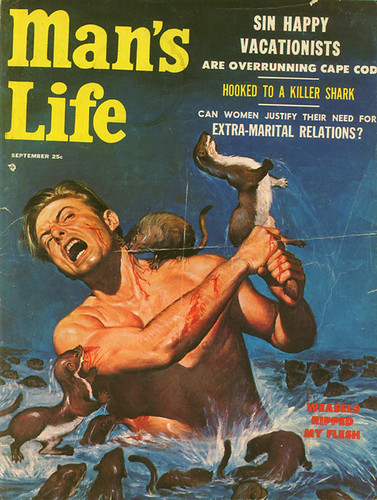
The cover of the September 1956 issue of "Man's Life" magazine.
There isn't an element of that cover that isn't brilliant in one way or another. If I had any talent as an artist, I'd render incidents from my own life in the same style.
Friday, July 06, 2007
Normal Service Is Resumed
OK, back to the normal pop-culture references. Over at The Simpsons Movie Site they have a character generator which you can use to make a Simpsons version of yourself. Here's how I might look in the Simpsons world:

It's not a terrible likeness, if I do say so myself.
It's not a terrible likeness, if I do say so myself.
Wednesday, July 04, 2007
Coming Soon
As it's now up on the website, I think it's appropriate to publish the abstract for the session I'm co-organising at the TAG 2007 conference. We're after papers for it, if anyone's interested.
Chance, Choice, and Catastrophe: An Archaeology of the Unpredictable
Archaeologists, regardless of their ideological stripe, have a tendency to look for recognisable patterns in the archaeological record. In many ways this is unsurprising, given archaeology’s origins as part of the Modernist project (Thomas, 2004), and the manner in which the western world is emerging from a period characterised by the two competing determinist schools of thought provided by Marxism and Free-Market economics (Ferguson, 1997). The question must be raised, however, as to how well archaeology deals with the random unpredictable event.
This is particularly relevant in light of recent scientific developments such as non-linear systems theory, which implies that the unpredictable is in fact a highly relevant factor in any complex system, which human culture certainly is. Such developments create a tension between the paradigms of the unpredictable event and gradual development, and those of individual agency and group dynamics. This session will therefore seek to present papers analysing the role of the unpredictable in archaeology, and how archaeology may incorporate such thinking into its work.
References
Ferguson, N. 1997. “Virtual History: Towards a ‘chaotic’ theory of the past”, in N. Ferguson (ed.) Virtual History: Alternatives and Counterfactuals. 1-90. London: Papermac.
Thomas, J. 2004. Archaeology and Modernity. London: Routledge.
Chance, Choice, and Catastrophe: An Archaeology of the Unpredictable
Stephen O’Brien, David Smith, Helen Murphy (University of Liverpool)
Archaeologists, regardless of their ideological stripe, have a tendency to look for recognisable patterns in the archaeological record. In many ways this is unsurprising, given archaeology’s origins as part of the Modernist project (Thomas, 2004), and the manner in which the western world is emerging from a period characterised by the two competing determinist schools of thought provided by Marxism and Free-Market economics (Ferguson, 1997). The question must be raised, however, as to how well archaeology deals with the random unpredictable event.
This is particularly relevant in light of recent scientific developments such as non-linear systems theory, which implies that the unpredictable is in fact a highly relevant factor in any complex system, which human culture certainly is. Such developments create a tension between the paradigms of the unpredictable event and gradual development, and those of individual agency and group dynamics. This session will therefore seek to present papers analysing the role of the unpredictable in archaeology, and how archaeology may incorporate such thinking into its work.
References
Ferguson, N. 1997. “Virtual History: Towards a ‘chaotic’ theory of the past”, in N. Ferguson (ed.) Virtual History: Alternatives and Counterfactuals. 1-90. London: Papermac.
Thomas, J. 2004. Archaeology and Modernity. London: Routledge.
Friday, June 29, 2007
Thanks To YouTube
Sometimes there are bands that go beyond producing songs that you like. Sometimes there are bands that do the things that you think you'd do, if you were to be a band.
Case in point? This 1978 performance by Devo on French TV , doing their cover of The Rolling Stones' "Satisfaction":
Case in point? This 1978 performance by Devo on French TV , doing their cover of The Rolling Stones' "Satisfaction":
Sunday, June 24, 2007
26th Birthday
'I'm thirty', I said. 'I'm five years too old to lie to myself and call it honour.'
- F. Scott Fitzgerald, The Great Gatsby (1926)
Heh.
It occurs to me that my birthday was last Sunday, but I hadn't actually mentioned it here yet. I actually spent it in London with my sister, who noted that she never seems to feature here.
We had tickets to two days of the Wireless Festival in Hyde park , which allowed me to see The White Stripes and The Kaiser Chiefs headlining. The foirmer were predictably good, but the latter actually sold me on them as a band - I'd liked some of the singles, but as a live act they were really excellent.
Other highlights included seeing The Only Ones playing their herointastic "Another Girl, Another Planet" (currently to be heard selling mobile phones), beneatha rival mobile company's logo, the lead singer of The Cribs biting off far more than he could chew when he dived into the crowd, and the fresh faced youngsters of Mumm-Ra experiencing a positive reaction to a new song ("Did you like that? Ooh, we'll use that one!").
Tuesday, June 12, 2007
Origins

From the online comic Shortpacked. I often find the occasional superhero jokes like this to be better than the regular comic, but that could just be me.
Thursday, June 07, 2007
God Save Your Mad Parade
Suddenly you didn't have to be alone. You submerged. You had a good time by having a bad time. You were full of poison.
- Jon Savage, England's Dreaming (1991)
Yes, it's now 30 years since punk's high point - causing there to be no Number One single in the week of the Queen's Silver Jubilee, because the top selling single was the Sex Pistol's "God Save The Queen" and the BBC didn't want to cause offence. That week, the charts ended at Number 2.
Why my favourite musical era is one which happeded a few years before I was born is an interesting question. I suspect that Jon Savage nailed it with that quote, however.
Why my favourite musical era is one which happeded a few years before I was born is an interesting question. I suspect that Jon Savage nailed it with that quote, however.
Thursday, May 31, 2007
Circular Chess
I really don't have a tactical brain. Therefore, no-one was more surprised than me when I won a game of "Cirondo" at RPG.soc yesterday. Cirondo is a sort of four-person circular chess with only three types of piece: pawns, bishops, and queens.
Admittedly, when two of the players had been eliminated, the third forgot one of the cardinal rules of the game: you lose when you have only one piece left. Still, a win's a win.
Admittedly, when two of the players had been eliminated, the third forgot one of the cardinal rules of the game: you lose when you have only one piece left. Still, a win's a win.
Saturday, May 19, 2007
The Director Did It
"This film is based on actual case files."
Most of the problems with David Fincher's Zodiac can be traced back to that sentence, which opens the film. Zodiac is the story of the investigation into the "Zodiac killer" who operated in California in the late 1960s and early 1970s.
The problem, however, is that having made the decision to be fairly factual with the case, Fincher is left with a standard police procedural story that wouldn't look too out of place on evening television. And as with real life, people fade in and out of the story. We are presented with four principle characters, two detectives and two journalists, but their narratives are insuficiently interlaced. It's almost as if two different films had been made and then cut together.
The attempt to stick to facts means that Fincher is unable to play to one of his strengths, the psychological aspects of the investigation. It's fairly obvious that Robert Graysmith (Jake Gyllenhaal) is a fairly creepy and obsessed individual, but, perhaps because the screenplay is based on Graysmith's book, this is glossed over, often being presented in comic terms.
Further problems are brought in when Fincher attempts to make the story more "Hollywood" bu introducing some standard thriller elements, which appear far-fetched and melodramatic.
The films strength is perhaps in giving a sense of time and place, with the fashions and soundtrack envoking the 1970s without descending into the over-the-top cliche version of the decade that we see all too often.
Overall, Zodiac isn't a bad film, it's just a solid, by-the-numbers film, but that's a disapointment, given the director and the subject matter.
Thursday, May 10, 2007
South Atlantic Wind Blows/Ice From A Dying Creed
People who know me well may have heard me talk about how, a few years back, I worked with a formed skinhead. He'd been the stereotype, even down to a swastika tatoo on his shoulder. He was a big fan of skinhead films (Made In Britain, Romper Stomper. Also Scum because he'd been in Borstal, but that's another story). As such, I wondered what he'd make of This Is England, which I saw at the cinema only the other day.
The film focusses on a small group of skinheads in the north of England in 1983, and attempts to show how what was originally a non-racist movement (starting with white working class kids imitating the fashions of hard Jamaican lads in the 1960s) was infilitrated and overtaken by Neo-Nazis in the 1970s and 1980s. More than that, it tries to show why membership of a group (whether of a "gang" or a Fascist party) can become so central to someone's life. This is the most successful aspect of the film, helped greatly by some excellent performances, both from the young cast, and from Stephen Graham as the sympathetic-demon "Combo".
Where the film perhaps falls down is its attempts to use the early 1980s as an analogy for the current state of the nation. Skinheads as hoodies is perhaps appropriate, but the presented ideology of the National Front seems a little too contemporary. The analogy of the Falklands War (sorry, "Conflict") with Iraq seems strange, too. There's no doubt that nearly 1000 people dying for some rocks inthe South Atlantic was a terrible waste (Borges famously described it as "Two bald men figting over a comb"), but it was also a response to an unprovoked invasion by a military dictatorship with an appalling human right record. Iraq somehow manages to make the Falklands look good.
All in all, though, it's well worth seeing given the current debate about Britishness (and, by extension, Englishness), and I certainly can't fault it for trying to talk abotut he consequences of being socially end economically isolated from the rest of society.
Friday, May 04, 2007
Fire
Because far too many people are still unaware of Arrested Development, which might just be the funniest American sitcom ever:
Tuesday, May 01, 2007
This Machine Kills Icelandic Management Lecturers
Yesterday my arsehole of a housemate (see previous posts/e-mails) left the house for the last time. The landlord finally lost patience with him a month ago and suggested that it might be better if he left.
The landlord wants to sell the house, so I shall still be moving before September. However, this is a huge victory for me and the other people in the house.
Champaigne will be drunk.
The landlord wants to sell the house, so I shall still be moving before September. However, this is a huge victory for me and the other people in the house.
Champaigne will be drunk.
Saturday, April 28, 2007
In Your Face, Ahmadinejad!
I recently installed the free StatCounter software on my blog, so that I could see how popular it is, and where people are viewing it from. The results were surprising. I'm predictably popular in Britain, although I'm not sure who keeps viewing from Birmingham. I've had views from as far away as Brazil and Mexico, too. What pleased me most, however, was the two visits I'd had from the Islamic Republic of Iran. What they made of it is anyone's guess.
The software also allows me to see what search-engine keywords have brought people to the blog. My favourite was the person who was looking for "Ladyboys of Bangkok in Nottingham". I can only assume that they were disappointed with what they found.
The software also allows me to see what search-engine keywords have brought people to the blog. My favourite was the person who was looking for "Ladyboys of Bangkok in Nottingham". I can only assume that they were disappointed with what they found.
Monday, April 23, 2007
The House That Jack Built

In many ways, it's amazing that it didn't occur to me sooner. Some of you may remember, about 15 years back, that a man in Liverpool claimed to have found Jack the Ripper's diary, implicating a Liverpool cotton merchant named James Maybrick as the murderer.
It occurred to me to wonder where Maybrick lived in 1888, and it turned out that it was at Battlecrease House, just up the road from where I live now. So on Saturday I went to take a look (Yes, I felt that finding the house of a possible Victorian serial killer was a perfectly normal way of spending a nice spring afternoon. Why do you ask?).
The diary, of course, is a fake. However, we can be certain that one Victorian murder case did involve Battlecrease: Maybrick's wife Florence was convicted of poisoning him with arsenic in May 1889, in one of the most famous murder trials of the era. As Alan Moore noted in From Hell, Maybrick being the Ripper would be like Sharon Tate turning out to be the Boston Strangler.
Of course, the diary being fake doesn't rule Maybrick out as a suspect, and while there's nothing to place him in London at the time of the murders, there's also nothing to establish that he wasn't. There are also a couple of curious details.
A few years back, interviews with elderly Liverpool residents indicated that, in the early years of the 20th Century, children used to run past Battlecrease and shout "Look out, look out, Jack the Ripper's about!". An urban legend about Maybrick may go back quite way.
There's also a detail of a letter that Florence Maybrick sent to her lover shortly before James' death, in which she reports that he is "Delirious...perfectly ignorant of everything", before going on to say that "The tale he told me was a pure fabrication and only intended to frighten the truth out of me."
There is, however, no indication as to what that tale was.
Tuesday, April 17, 2007
Buttle/Tuttle
So, a list of names of terrorist suspects is being used by banks and car-dealers to vet clients, and is causing problems for people who have names similar to those of terrorist suspects.
Look, having things from William Gibson novels come true is one thing, having things from Brazil come true is quite another.
Look, having things from William Gibson novels come true is one thing, having things from Brazil come true is quite another.
Saturday, March 31, 2007
Rage - Goddess, Sing...
Achilles. You're a good person to have around on the rare occasions you're ready to do some work, but you have volatility issues. Your willingness to enlist the help of your mum won't win you any friends, either
Which Homeric Hero Are You?
Crikey. I mean, it's accurate enough, but Achilles? Surely I should be someone who's more of a wuss, like Paris.
Which Homeric Hero Are You?
Crikey. I mean, it's accurate enough, but Achilles? Surely I should be someone who's more of a wuss, like Paris.
Saturday, March 24, 2007
THIS! IS! sorry, which city am I king of again?
It was inevitable that I would go and see 300 with a group of archaeologists, so it was no surprise when that happened last night.
I was particularly interested in seeing it, because an epic battle has recently been waged in the pages of RPG.net over the question of subtext. On one side are those who think that, given the current world-political climate, making a film in which Resolutely Heterosexual Spartan Manly-Men Who Don’t Wear Armour (all played by actors of solidly north-European ancestry) slaughter countless thousands of the Faceless Asiatic Hordes Who Are Led By A Ten-Foot-Tall Effeminate Bisexual (all played by extras who are distinctly either black or brown of skin-tone) might just be a bit troubling.
The counterpoint made was that the subtext is actually critical of the Spartans, and that the battle is really presented as a suitably Frank Miller tale of anti-heroes against villains.
Having seen the film, I can now tell you that the latter argument is complete bollocks.
I promise you that I’m not using hyperbole, or just being a shrieking lefty arts-student, when I say that 300 reminds me of nothing so much as Nazi propaganda films. It’s all here: the worship of the leader figure, the elite of perfectly sculpted male warriors, the idea that the enemy may not actually be human at all, and, of course, the Dolchstoß by corrupt politicians and sub-human mutants. It all reminds me far too much of Spinrad’s novel The Iron Dream. And sadly, this isn’t a satire like that novel, or like Verhoeven’s Starship Troopers. You are quite explicitly supposed to identify with and admire this film’s Spartans.
Don’t get me wrong. If you’ve seen this film and liked it, I’m not saying that you’re a Nazi: the visuals are quite spectacular, although I’m not sure I liked them as much as the look and feel of something like Hero (another film with some troubling politics). It’s just that for me, the visuals don’t disguise what is, in fact, a very troubling subtext.
It will still be worth your while seeing it if you’re interested, if only so that you can e-mail me and tell me that I’m completely wrong. Of course, if I am wrong, then 300 is two hours of vacuous macho bullshit, nonetheless.
Friday, March 16, 2007
A Spectre Haunting Europe
What's a picklock compared to a share certificate?
What's robbing a bank compared to founding a bank?
What's robbing a bank compared to founding a bank?
- Bertolt Brecht, "Happy End" (1929)
Well, I now have an ISA, which I think makes me officially bourgeois. On the other hand, I was kind of born like that. Either way, Trotsky wouldn't be too pleased with me.
On a not-completely-unrelated point, I've recently been looking on ebay for a bust of Marx. I should be getting desk-space in an office next year, and I need something to mark my territory. The interesting thing is that Marx is pretty hard to find, and is much more expensive than either Lenin or Stalin. There's almost certainly an incredibly clever joke about the market in there, but I'll be blowed if I can put it together.
The question is, what will people think the meaning of a bust of Marx is when they see it? Am I referring to myself as a Marxist, and if so, what does that mean? I agree with large chunks of the Marxist critique of Capitalism, but generally disagree with the preposed solutions. I like the democratic process, for a start, and I'm not a utopian, so I don't think you'll ever achieve a perfectly equal society. But that doesn't mean I can't believe in a more equitable distribution of wealth, and be somewhat doubtful that Free-Market Capitalism is going to deliver a good standard of living on a global scale.
Of course, there's a good 150 years of evolving Marxist thought, some of which is more in line with my way of thinking. I've got a lot of reading still to do. I suppose the bust of Marx would be similar to a psychologist having a bust of Freud - it's recognition that he started something important, rather than complete agreement with everything he said. You can't rely on people to magically realise that, though.
Subscribe to:
Posts (Atom)