Monday, July 22, 2024

Seeing on Behalf of a State

The quasi-Anarchist anthropologist James C. Scott died on Friday. Something which has been missing from lots of people's tributes over the last couple of days is this information, from Todd Holmes' oral history interviews with Scott published a few years ago:

So I had also, not knowing what to do, I applied to join the CIA. I had applied to Harvard Law School and had been accepted, and on a kind of flash of daring, I applied for a Rotary Fellowship to Burma, and I got the Rotary Fellowship to Burma. I thought to myself, I can postpone Harvard Law School, I can always go to law school, but when am I going to get a chance to go to Burma? And so, I decided to go to Burma and spent a year there, and in the meantime—this is not in a lot of my stuff—the CIA people asked me to write reports on Burmese student politics and so on, which I did. Then they arranged through the National Student Association to have me go to Paris for a year and be an overseas representative for the National Student Association. I went to the Congo; I went to Ghana; I went to, oh, Scotland. I spoke at the French National Student Union meeting. I went to the Polish—first American to go to the Polish National Student meeting, et cetera. It was quite an experience.

A few pages later we get this:

I went to Jakarta and Bandung, so I had a little Indonesian experience, and then I went to what was then East Pakistan, Dhaka, and I went to Singapore. In Singapore, I got to know the Socialist student union people, the sort of so-called Dunham Road Hostel, many of whom became very important politicians later on, and personal friends in some cases. So at the end of my Burma year, I saw, if you like, student politics in three or four different places, and including—we're talking '60, and so I met the sort of Communist leaders of the CGMI, which was the Communist student union in Indonesia, most of whom were killed after '65, and so on.
It just seems like the kind of thing that needs to be in the little potted biographies, in order to give a fuller picture. 

It's not particularly a surprise that anthropologists and archaeologists get recruited as assets by intelligence services, although it tends not to be remarked upon much from inside the profession other than by David Price, and as he's remarked, doing so "is not thought to be a good 'career builder'."

Tuesday, June 25, 2024

The Last Stone Age Man

History records that Ishi, a.k.a. the Last Yahi, the Stone Age Ishi Between Two Worlds, was captured by northern Californians in 1911 and dutifully turned over to anthropologists. He spent the rest of his life in a museum in San Francisco. (And you think your life is boring.)

They said Ishi was the last North American Indian untouched by civilization. I don’t know about that, but it’s clear he was really country and seriously out of touch with recent developments. We’re talking major hayseed.

His keepers turned down all vaudeville, circus, and theatrical offers for the living caveman, but they weren’t above a little cheap amusement themselves. One day they took Ishi on a field trip to Golden Gate Park. An early aviator named Harry Fowler was attempting a cross-country flight. You can imagine the delicious anticipation of the anthropologists. The Ishi Man versus the Flying Machine. What would he make of this miracle, this impossible vision, this technological triumph? The aeroplane roared off into the heavens and circled back over the park. The men of science turned to the Indian, expectantly. Would he quake? Tremble? Would they hear his death song? Ishi looked up at the plane overhead. He spoke in a tone his biographers would describe as one of “mild interest.” “White man up there?”

– Paul Chaat Smith, Everything You Know About Indians Is Wrong (2009)

Monday, April 29, 2024

The Letterboxd Years

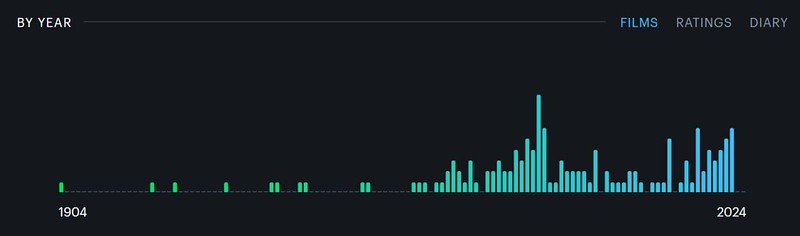
So a year ago I posted my Letterboxd stats on what years the films I watched were made in and said that I was going to try and watch more films from before the 80s. Here's the updated chart including the films I've watched over the last year: 

Letterboxd 2024

Still a big spike in the 80s, but I've successfully pushed back into earlier decades a bit. Maybe one day I'll have watched a film from every year?

Sunday, March 03, 2024

Wednesday, January 31, 2024

On Pirates

There's a fragment of Cicero's Republic from around 51 BC that recounts the story of a captured pirate captain who was brought before Alexander the Great. Alexander has one main question for the pirate, and the anecdote finishes like this:
 . . . for when he was asked what wickedness drove him to harass the sea with his one pirate galley, he replied, "The same wickedness that drives you to harass the whole world."
– Cicero, Republic 3.14 (translation by C.W. Keyes)

Sunday, April 30, 2023

Burned Cities

Thanks to my sister, I've been lucky enough over the last year or so to go to a couple of performances of the immersive production The Burnt City. It takes place in a Troy which is simultaneously Schliemann's excavation, the ancient city, and a Blade Runner-type Art Deco dystopia. As their own website says, "As night falls, Gods, mortals, dreamers and lovers come alive – one last time."

So I was interested recently when I came across this passage from Arthur Evans' excavation report on Knossos, The Palace of Minos III (1930):

The Grand Staircase as thus re-compacted stands alone among ancient architectural remains. With its charred columns solidly restored in their pristine hues, surrounding in tiers its central well, its balustrades rising, practically intact, one above the other, with its imposing fresco of the great Minoan shields on the back walls of its middle gallery, now replaced in replica, and its still well-preserved gypsum steps ascending to four landings, it revives, as no other part of the building, the remote past. It was, indeed, my own lot to experience its strange power of imaginative suggestion, even at a time when the work of reconstitution had not attained its present completeness. During an attack of fever, having found, for the sake of better air, a temporary lodging in the room below the inspection tower that has been erected on the neighbouring edge of the Central Court, and tempted in the warm moonlight to look down the staircase-well, the whole place seemed to awake awhile to life and movement. Such was the force of the illusion that the Priest-King with his plumed lily crown, great ladies, tightly girdled, flounced and corseted, long-stoled priests, and, after them, a retinue of elegant but sinewy youths—as if the Cup-bearer and his fellows had stepped down from the walls—passed and repassed on the flights below.


Tuesday, February 28, 2023

Big Gaps Before the 80s

One of the things Letterboxd lets you do is see what films you've watched by release year. Here's what my efforts so far look like.

Letterboxd Films By Year

1988 seems to be the year I home in on, but I could do with watching more films from before the 80s in general.

Thursday, March 31, 2022

It's Literally a Spectre. It's Scary as Hell.*

To what extent Marx and/or Engels encountered occultists or their literature is not known, and is certainly not a question that has interested any of their biographers. It cannot be said that the passing references to alchemy and the Philosophers' Stone in their writings indicate any familiarity with original hermetic sources. We do know, however, that they shared Hegel's high esteem for the sixteenth-century German mystic and heretic Jacob Boehme, saluted by Marx in the Rheinische Zeitung in 1842 as "a great philosopher." Four years earlier Engels had made a special study of Boehme, finding him "a dark but deep soul," "very original " and "rich in poetic ideas." Boehme is cited in The Holy Family and in several other writings of  Marx and Engels over the years.

One of the things that may have attracted them to Boehme is the fact that he was very much a dialectical thinker. Dialectic abounds in the work of many mystical authors, not least in treatises on magic, alchemy and other "secret sciences" and it should astonish no one to discover that rebellious young students of Hegel had made surreptitious forays onto this uncharted terrain in their quest for knowledge. This was certainly the case with one of Marx's close friends, a fellow Young Hegelian, Mikhail Bakunin, who often joined him for those all-night discussions at Proudhon's. As a young man the future author of God and the State is known to have studied the works of the French mystic, Louis Claude de Saint-Martin, "The Unknown Philosopher" and "Lover of Secret Things," as well as of the eccentric German romantic philosopher, Franz von Baader, author of a study of the mysterious eighteenth-century Portuguese-Jewish mage, Martinez de Pasqualis, who is thought by some to have had a part in the formation of Haitian voodoo (he spent his last years on the island and died in Port-au-Prince in 1774), and whose Traité de la réintégration is one of the most influential occult writings of the last two centuries.
- Franklin Rosemont, "Karl Marx & The Iroquois", (1989)

*This joke stolen from a Nick Pinkerton Tweet that now seems to have been deleted.

Friday, February 18, 2022

Nom de guerre

FLiWRW9XEAQQ__2

That symbol on the green chest patch is a Wolfsangel, as used by the 2nd SS Panzer Division, so I suspect he knew what he was doing when he told them that his surname was "Friekorps".

Sunday, January 30, 2022

The Importance of Procopius

The historical King Arthur seems to have been a petty British King, a commander of allied cavalry, whom the Romans left to his fate when their regular infantry were withdrawn from the garrison towns of Britain at the beginning of the fifth century. If a Procopius had been his chronicler, the ogres and fairy ships and magicians and questing beasts would not have figured in the story except perhaps as a digressive account of contemporary British legend. Instead we should have a lucid chapter or two of late Roman military history – Arthur's gallant attempt to preserve a remanant of Christian civilization in the West country against the pressure of heathen invasion. And Arthur's horse would have been a big-boned cavalry charger, not a fairy steed flying him wildly off towards the Christian millennium.

- Robert Graves, Foreword to Count Belisarius (1938)

Friday, December 31, 2021

Films I Saw in 2021

 Now that I've started using Letterboxd I can pull up neat statistics about what I saw this year. Here's a list of what I saw:

Films2021

and here's a world map of where they're from (Hong Kong not visible at this scale):

FilmMap2021

Saturday, September 25, 2021

Huemac

1bfxhdW

IUnChpV

From Camilla Townsend's Fifth Sun: A new history of the Aztecs (2019).

Tuesday, August 31, 2021

Meditations

 Extract from Sean T. Collins' Pain Don't Hurt: Meditations on Road House (2020).

Friday, July 30, 2021

Wednesday, March 31, 2021

Heavy Overhead

Heavy Overhead by Jen Orpin

"Heavy Overhead" by Jen Orpin.

Thursday, December 31, 2020

The British Way of Life

...I swallow my dreams like my beer...


The British Way of Life - The Chords (1980)


Sunday, November 22, 2020

The Archaeology of Dealey Plaza (2)


DRAIN08B

Photograph by Michael Parks.

A bit of industrial stratigraphy. Some theories claim that the fatal shot fired at Kennedy came from the storm drain on Elm Street, at the foot of the grassy knoll, hence the potential importance of the differing street levels between 1963 and the present day in terms of determining whether or not such a shot would even have been possible. 

Given that the only exits from the drain are a manhole up to street level and pipes that are 12" and 15" in diameter, it is perhaps an unlikely location for someone who would be looking to get away quickly. 

Saturday, October 31, 2020

Closing Speech

It's not that it's not difficult to escape death, gentlemen, but it's much harder to escape wickedness, since it runs faster than death. And now, because I am a slow old man, I am being overtaken by the slower of the two, and my accusers, because they are clever and keen, by the swifter, by evil. And I am going away now, having been condemned to death by you, while they have been condemned by the truth to depravity and injustice. And both I and they will keep to our punishment. Perhaps this is how it had to be, and I suppose it's appropriate.

Next, I want to foretell the future to you my condemners, since I am now at the moment when men especially prophesy, whenever they are about to die. I declare that retribution will come to you swiftly after my death, you men who have killed me, and more troublesome, by Zeus, than the retribution you took when you sentenced me to die. You have done this just now by trying to avoid giving an account of your life, but I think the complete opposition will happen: you will have more prosecutors—whom I was holding back until now, though you did not notice—and as they are younger they will be more troublesome, and you will be more enraged. If you think that killing people will prevent anyone from rebuking you for not living properly, you are not thinking straight, since this escape is scarcely possible nor noble, whereas escape from the other is noblest and easiest: not by cutting down others but equipping oneself so that one can be as good as possible. With this prophecy to you who sentence me, I depart.

From Socrates' speech to the court following his death sentence in 399 BC, at least according to Plato's Apology. This translation is by Cathal Woods and Ryan Pack.


Friday, August 14, 2020

Out of Time

I stopped laughing, crying, eating, sleeping…I just stopped. I was like a ghost, haunting my own life, going through the motions, but living even less than I had before. I became hyper-obsessed with the past—back when I was still happy and unperturbed by these thoughts and still had time left; the past also became a concept I loathed because it housed all of the mistakes that led me here, to this misery in which the second half of your 30s can somehow feel like The End, like it’s already too late to start over. I no longer felt like the central character in my life story, like the Hero; instead, I felt like the Heavy who’d destroyed any chance of true usefulness in my life.

Being a Quentin Tarantino film, Once Upon a Time...in Hollywood, which I first saw a year ago on the day of its UK release, was divisive. It was certainly my film of 2019 and in my view Tarantino's best film this century. Woods' extremely personal long read on the film mirrors a lot of my own thoughts on it and certainly explains why, as with him, it mattered so much to me.