Sunday, November 09, 2014

"But I Love...I Love All...All People..."


On 13 November 1989, six days after the fall of the Berlin Wall, Erich Mielke addressed the parliament of the German Democratic Republic in his role as Minister of State Security. When one member of the parliament objected to his use of the term "comrades" to address them, he replied "But I love...I love all...all people...".  The room could only laugh.

I know about Mielke, and about the above clip, because of Philip Kerr's novel Field Grey (2010).

Thursday, October 30, 2014

RPG LOL

RPG LOL

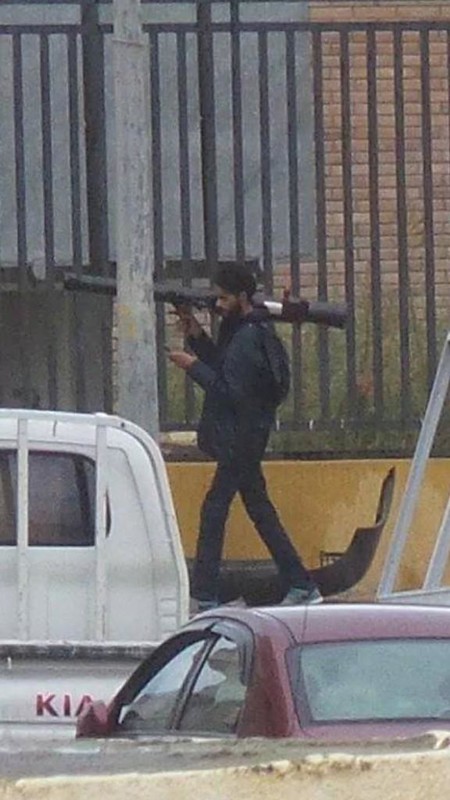
Taken in Libya, this is probably the best illustration of how 21st century insurgencies are fought. Image from the @Rekka_K Twitter account.

Tuesday, October 07, 2014

Computer Security


Monday, August 25, 2014

Dame With A W

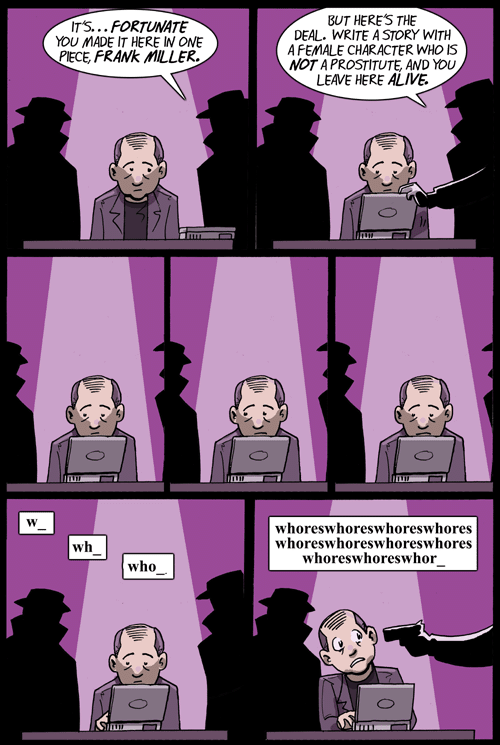
In honour of the release of Sin City: A Dame To Kill For, here's one of the finest moments from Shortpacked!:

Shortpacked on Frank Miller

Monday, July 28, 2014

Centenary

'I say, is it really true that the French artillery had to fire on their infantry?' Delaforce asked. 'To drive them over the top?'
'Absolutely,' Finlayson said. 'They had a mutiny. The troops wouldn't leave the trenches, so the French generals laid down a barrage on them. That soon shifted them.'
'What happened afterwards?'
'Afterwards? There was no afterwards. Why d'you think they didn't want to get out of the trenches?'
- Derek Robinson, Goshawk Squadron (1971) 

Thursday, July 17, 2014

A Storm In Macedonia

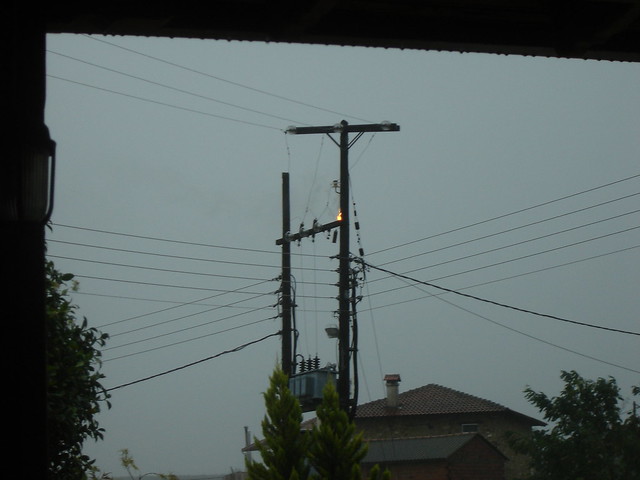
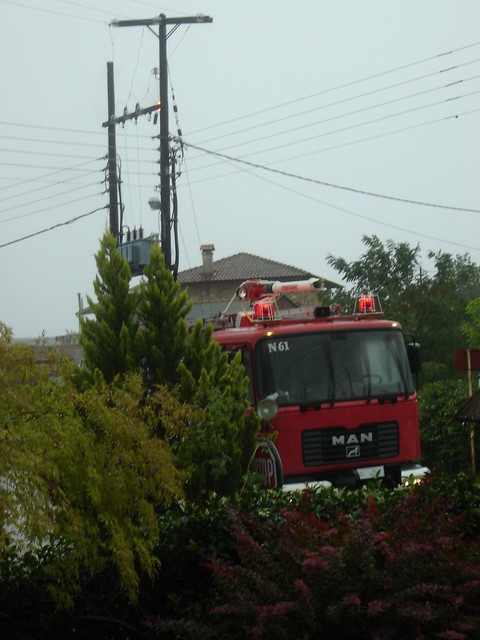
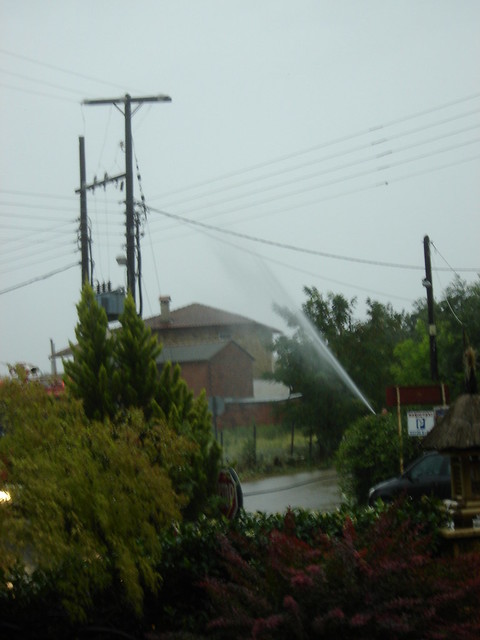
I'm currently at Olynthos in northern Greece, excavating on the Classical city site. On Tuesday we couldn't work because of torrential rain and a thunderstorm. During the storm, lightning struck the electricity pylon just across the road, about 20 metres from where I was sitting. The pylon was knocking out and a small fire started, which had to be put out by the local fire brigade. These are the photos I took of that:

Lightning Strike 1

Lightning Strike 2 

Lightning Strike 3

In terms of actual archaeology, we don't really have any features in the trench yet, but we have had a couple of interesting finds: a stone tool which might be prehistoric, but could also be the sort of thing a Classical potter might have used to burnish pottery, and a sling bullet which is almost certainly from the siege which destroyed Olynthos in 348 BC. This is my photo of the latter:

  Olynthos Sling Bullet

EDIT 27/07/14: I've taken the picture of the sling bullet down, both because it is unpublished archaeological material, and because we don't want to encourage looting on the site.

Sunday, June 22, 2014

Kohima-Imphal

While the 70th anniversary of D-Day got fairly extensive coverage recently, I've seen pretty much nothing about the fact that it's also 70 years since the battle of Kohima-Imphal, the most significant battle of the Second World War in south-east Asia. It's not too difficult to discern the difference in coverage, as fighting to liberate France from the Nazis has very different connotations to fighting in order to keep Burma British.

Nonetheless I feel I should mention it, as my grandfather on my Dad's side was there, with the 2nd battalion of the South Lancashire Regiment. This article suggests that there are now only three surviving members of the Burma Star Association, although, of course, the vast majority of Commonwealth troops in the battle were Indian. Also, Dad tells me that Grandad never actually joined the Burma Star Association, believing it to be full of clerks and other rear-echelon types.
Friday, June 06, 2014

I Survived Able Archer 83

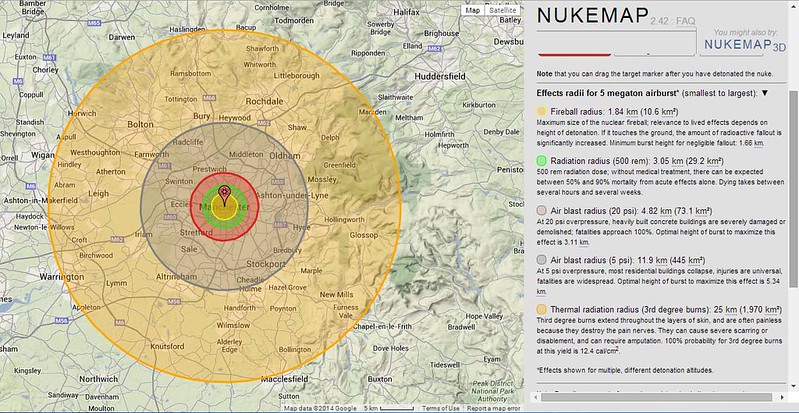
Borrowing a trick from Blood & Treasure, an article over at the Guardian suggests that Manchester was destined to be the recipient of "one or two 'airbursts' of up to five megatons" in the event of war with the Soviet Union. The Nukemap website suggests the following effects for a five megaton airburst over Manchester:

nukemap

Heaton Chapel is just to the north-west of Stockport, so I don't fancy two year-old me's chances very much.

Friday, May 30, 2014

Minimum Wage

J.T. once asked me what sociologists had to say about gangs and inner-city poverty. I told him that some sociologists believed in a "culture of poverty" - that is, poor blacks didn't work because they didn't value employment as highly as other ethnic groups did, and they transmitted this attitude across generations.

"So you want me to take pride in the job, and you're only paying me minimum wage?" J.T. countered. "It don't sound like you think much about the job yourself."
- Sudhir Venkatesh, Gang Leader for a Day: A rogue sociologist crosses the line (2008)

Saturday, April 05, 2014

Coup Leader Kills Himself

Nirvana in London, 1991

Monday, March 31, 2014

Writing Terror

So for various reasons, I've recently been investigating what's been written about the European terrorism of the 1970s/1980s. One of the things which is striking is how the "terrorist memoir" seems to be a niche sub-genre these days. This year one of November 17 published Γεννήθηκα 17 Νοέμβρη, but there are a couple of efforts from Baader-Meinhoff and other German groups, and the occasional Red Brigader. Even Britain gets in on the act with Stuart Christie's Granny Made Me An Anarchist. What's curious is that even though right-wing terrorist groups were pretty prominent during the same period, they don't seem to be represented in the memoirs market, and I'm wondering why that is. Lack of the literary/intellectual tradition that the left has? Publishers less sympathetic? Something else?

Friday, February 28, 2014

The Wrong Kind of Cynicism

And, vexingly for Eric, on the rare occasions he’s convinced a journalist that the CIA murdered his father, the revelation has not been greeted with horror. One writer declined Eric’s invitation to attend his press conference saying, ‘We know the CIA kills people. That’s old news.’
In fact, Eric told me, this would be the first time anyone had ever publicly charged the CIA with murdering an American citizen.
‘People have been so brainwashed by fiction,’ said Eric as we drove to the local Kinko’s to pick up the press releases for the conference, ‘so brainwashed by the Tom Clancy thing, they think, “We know this stuff. We know the CIA does this.” Actually, we know nothing of this. There’s no case of this, and all this fictional stuff is like an immunization against reality. It makes people think they know things that they don’t know and it enables them to have a kind of superficial quasi-sophistication and cynicism which is just a thin layer beyond which they’re not cynical at all.’
- Jon Ronson, The Men Who Stare at Goats (2004)

The story of Eric's father, Frank Olson, and why he may have been murdered, can be found here, as well as in Ronson's book.

Saturday, January 25, 2014

Bleak Mouse


I think I preferred it when you were into opium, Micky.

Tuesday, December 31, 2013

The Road Warrior


This is a homemade armoured vehicle being used by the Kurdish YPG militia in north-east Syria (the photo is from the Avashin Twitter account). It's interesting to wonder about the influence of films like Mad Max on this, although improvised armoured fighting vehicles date back to the Spanish Civil War.

Monday, December 16, 2013

The 嫦娥 Has Landed

A video of the Chinese "Jade Rabbit" lander touching down on the Moon. As various people on the internet are pointing out, if you're under 37, these are the first pictures taken on the surface of the Moon during your lifetime.

Friday, November 22, 2013

Beaucoup Theories

There's supposed to be a half-dozen or six dozen or two dozen more fucking plots in the works, like the fucking assassination metaphysic is just out there too undeniably -


- James Ellroy, American Tabloid (1995)


Theories! We were almost lost in theories, there were so many of them.

- Inspector Frederick Abberline, lead investigator of the "Jack The Ripper" murders, quoted in Cassell's Saturday Journal, May 22nd 1892

Monday, November 18, 2013

Red Heat

The Blog Vintage Everyday has some great Soviet police posters dating from the 1950s to the 1980s. Here are my favourites:

Soviet Police 1
TALK TO THE HAND!

Soviet Police 2
Soviet law enforcement was equipped with the MASSIVE SLEEVES OF JUSTICE.

Soviet Police 3
In fairness, this isn't much creeper than police posters I see in contemporary Britain.

Soviet Police 4
I would watch the hell out of this film.


Wednesday, September 25, 2013

ANTHROPOID

Up to now, the Nazis, if somewhat halfhearted in the concealment of their crimes, have nevertheless kept up a superficial discretion that has enabled some people to avert their gaze from the regime’s true nature. With Lidice, the scales have fallen from the whole world’s eyes. In the days that follow, Hitler will understand. For once, it is not his SS who will be let loose but an entity whose power he does not fully grasp: world opinion. Soviet newspapers declare that, from today, people will fight with the name Lidice on their lips – and they’re right. In England, miners from Stoke-on-Trent launch an appeal to raise money for the future reconstruction of the village and come up with a slogan that will be echoed all around the world: 'Lidice shall live!' In the United States, in Mexico, in Cuba, in Venezuela and Uruguay and Brazil, town squares and districts, even villages, are renamed Lidice. Egypt and India broadcast messages of solidarity. Writers, composers, filmmakers and dramatists pay homage to Lidice in their works. The news is relayed by newspapers, radio, and television. In Washington, D.C., the naval secretary declares: 'If future generations ask us what we were fighting for, we shall tell them the story of Lidice.' The name of the martyred village is scrawled on the bombs dropped by the Allies on German cities, while in the East, Soviet soldiers do the same on the gun turrets of their T34s. By reacting like the crude psychopath that he is (rather than the head of state that he also is), Hitler will suffer his most devastating defeat in a domain he once mastered: by the end of the month the international propaganda war will be irredeemably lost.

But on June 10, 1942, neither he nor anyone else is aware of all this – least of all Gabčík and Kubiš. The news of the village’s destruction plunges the two parachutists into horror and despair. More than ever, they are wracked by guilt. No matter that they have rid Czechoslovakia and the world of one of its most evil creatures – they feel as if they themselves have killed the inhabitants of Lidice.

No one ever manages to persuade them that Heydrich’s death was good for anything.

Perhaps I am writing this book to make them understand that they are wrong.

 - Laurent Binet, HHhH (2012)

Monday, September 02, 2013

A Gazely Stare


Now all I have to do is work out the single most unsettling place in the house to put it.